Opportunities
Join the ARC Training Centre for Archaeology in the Resources Sector
Cultural heritage management in mining is a high-stakes field undergoing significant change – and there’s a global shortage of researchers with the skills to lead it.
The Centre’s PhD and postdoctoral positions offer you the opportunity to do impactful research at the intersection of archaeology, Indigenous knowledge and the resources sector. You’ll work with Traditional Owners and industry leaders and senior executives on major challenges – and emerge with the skills and networks to further your career and make a difference.
Our Centre is based at Flinders University in partnership with The University of Queensland and Southern Cross University. It brings together Traditional Owners, resource companies, archaeologists, and cultural and heritage experts to train the next generation of cultural heritage professionals and create new approaches to safeguard Indigenous cultural heritage.
A national research cohort
The Centre’s PhD candidates and postdoctoral researchers belong to a structured community that spans three universities, multiple disciplines and a range of industry and Indigenous partners.
Our cohort model provides support and connection - it is central to how we operate.
It creates a shared intellectual environment where you learn, not only from supervisors and industry mentors, but also from each other. Through regular workshops and seminars, industry placements, and activities with allied research centres, you will gain practical skills and a ready-made network to support you throughout your career.
Cultural heritage management in mining is a complex, interdisciplinary and high-stakes endeavour. It needs people who can collaborate, communicate and navigate diverse perspectives across academia, Indigenous organisations and industry. We prepare you for this environment.
All PhD candidates and postdoctoral researchers are based at their enrolling university – Flinders University, The University of Queensland or Southern Cross University – and are active and embedded within the Centre’s national cohort.
Skills development and training
We equip the Centre’s PhD candidates and postdoctoral researchers with the diverse skills required to become leaders in cultural heritage management through bespoke workshops and seminars, such as:
- Ethics training
- AusIMM workshops
- Diversifying language and communication skills
- Conscious and unconscious bias training
- Academic and industry writing
- Media training
- Native Title and compensation for cultural loss
- Entrepreneurial skills, including workplace dynamics and career pathways
- Understanding Indigenous governance structures (e.g., Prescribed Body Corporate)
- Understanding mining company organisational ecosystems
- Social impact assessment (SIA)
- Negotiation and stakeholder engagement skills
- Cultural competency and cultural awareness training
- Applying for industry-related research grant
Available PhD projects
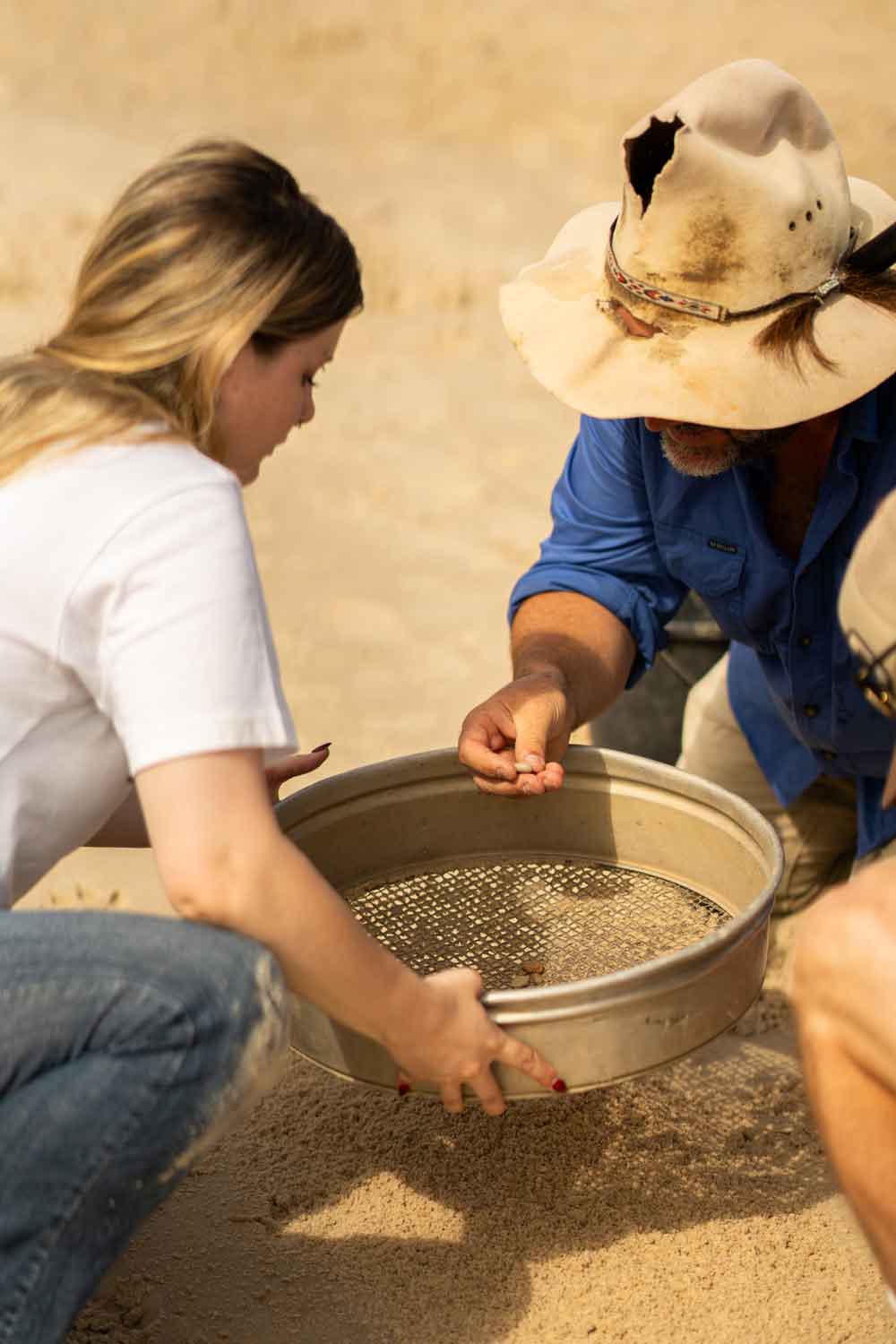
Geochemical Provenancing of Material Culture in Arid Landscapes
Southern Cross University, Lismore, New South Wales
Research Program #1 – Technological adaptation and implementation
Indigenous Rights
The University of Queensland, Brisbane, Queensland
Research Program #3 – Organisational Dynamics
Cultural Heritage as a Decision Maker
The University of Queensland, Brisbane, Queensland
Research Program #3 – Organisational Dynamics
Co-Designing Indigenous-Led Training Models in Cultural Heritage Science and Practice
Southern Cross University, Lismore, New South Wales
Research Program #4 – Knowledge Systems and Two-way Learning
Lidar: Detecting Archaeological Landscapes with Airborne LiDAR and Remote Sensing
Flinders University in Adelaide
Research Program #1 – Technological adaptation and implementation
Archaeology and Cultural Heritage Management in Risk Assessment
The University of Queensland in Brisbane
Research Program #3 – Organisational Dynamics
Indigenous Data sovereignty
The University of Queensland in Brisbane
Research Program #4 – Knowledge Systems and Two-way Learning
PhD scholarships
What we offer:
- Archaeological training from world leaders in the discipline, informed by Traditional Owner knowledge
- A national network across three universities and a diverse range of partner organisations
- Opportunities to shape the future of archaeology, cultural heritage management and social performance in mining
- Skills strongly sought worldwide by employers in industry, academia and Indigenous organisations
- A 12-month placement with partner organisations for practical experience and professional development
- A stipend of $41,555 per year indexed annually for 3.5 years, with tuition fees paid and assistance with project expenses
All PhD projects are full-time. Candidates are physically based at one of our partner Universities to ensure the full experience across research, training and collaboration activities, and the benefits of a supportive cohort setting.
International applicants should be aware that the cost of mandatory Overseas Student Health Cover is unfortunately not provided by this scholarship.
How to apply
PhD applications must be for a specific project and include the following:
- Cover letter
- CV
- Transcripts
- Two academic reference contact details, including one from your most recent supervisor
To apply, email PhD applications to: archaeologytrainingcentre@flinders.edu.au.
Available postdoctoral research positions
Advancing Geochemistry and Geochronology in Cultural Heritage
Southern Cross University Analytical Hub, Lismore, New South Wales
Research Program #1 – Technological adaptation and implementation
Drilling, Blasting and Impacts
Flinders University, Adelaide, South Australia
Research Program #2 – Best-practice frameworks
Social Responsibility
The University of Queensland, Brisbane, Queensland
Research Program #3 – Organisational Dynamics
What we offer:
- A national network across three universities, diverse partner organisations and the resources sector
- Opportunities to shape the future of archaeology, cultural heritage management and social performance in mining
- Skills strongly sought worldwide by employers in industry, academia and Indigenous organisations
- Assistance with budget for project expenses.
Duration of position is project-dependent and specified in the advertisement. All positions are physically based at a partner University to allow for research, training and collaborative activities, and the benefits of a supportive cohort setting.
How to apply
Submit your application for a specific project via the employing institution’s vacancy system as detailed in the advertisement:
- Cover letter addressing selection criteria
- CV
- Transcripts
- List of Publications (if available)
- Two academic reference contact details, including one from your most recent supervisor